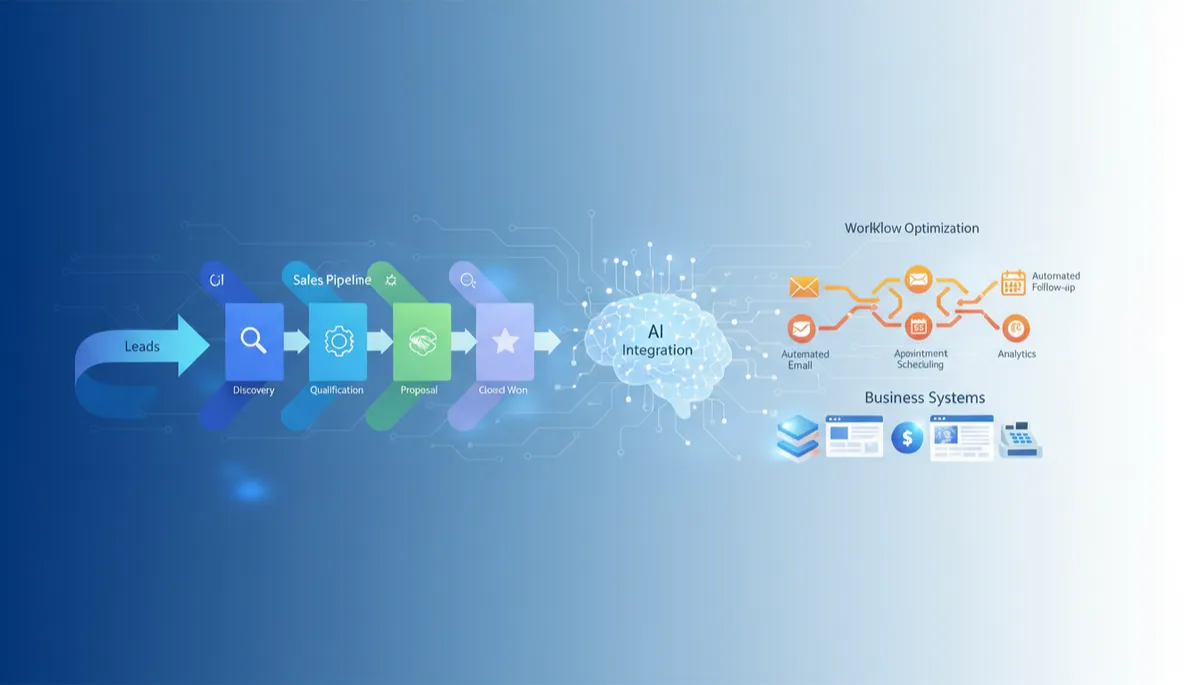
CRM Automation Guide: Leads, Pipelines & AI
CRM Automation, Lead Management, Workflow Optimization, AI Integration, Business Systems, Sales Pipelines
The Complete Guide to CRM Automation for Growing Businesses: Leads, Pipelines, Workflows, AI & Follow-Up
This guide is written for owners and agencies who are tired of juggling tools, chasing leads manually, and guessing what happens after someone fills out a form. From the perspective of operators who actually build and run these systems, we’ll break down how CRM Automation should work in the real world—and how House of Karma helps you connect brand, website, marketing, and sales into one controlled, scalable ecosystem.
1. What CRM Automation Actually Is (Not Just “Drip Emails”)
Most teams think of CRM Automation as “a few email sequences” or “some reminders.” That’s a tiny slice of the picture. In practice, CRM Automation is the set of rules, workflows, and triggers that move a contact through your Sales Pipelines, keep data clean, coordinate teams, and ensure that no meaningful lead or customer action depends on someone remembering to do it manually.
At its best, CRM Automation turns your CRM from a static database into an active system that:
Captures leads from every source automatically and tags them correctly.
Routes leads to the right person or pipeline based on rules you define.
Triggers timely follow-up across email, SMS, and tasks without manual effort.
Surfaces the next best action for each deal using AI Integration and data.
📌 Key Takeaway: CRM Automation is about orchestrating your entire revenue process, not just sending automated emails.
2. What a CRM Should Do for a Growing Business
A CRM is not “a fancy spreadsheet in the cloud.” If it feels like that, it’s either configured poorly or you picked the wrong tool. A modern CRM, especially for ambitious service businesses and agencies, should act as the operating system for your customer relationships and revenue.
At a minimum, your CRM should:
Centralize all contacts, companies, and deals with a clear history of every interaction.
Visualize Sales Pipelines with clear stages that match how you actually sell (not how the software defaults are labeled).
Automate repetitive Lead Management tasks: assigning owners, updating stages, logging activity, and following up.
Provide reporting that answers simple questions: Where are leads coming from? Where do we lose them? What’s our close rate by source and stage?
💡 Pro Tip: If your CRM can’t tell you, in one click, how many leads came from your website last month and how many closed, you don’t have a system—you have storage.
3. How Leads Flow Through a CRM in a Healthy System
Lead flow is where most implementations fall apart. Forms exist, ads run, calls happen—but no one can clearly map what happens from first touch to closed deal. Let’s walk through a clean, practical flow House of Karma often designs for clients.
A Practical Lead Flow Example
Capture: A visitor fills out a website form, books a call, downloads a guide, or messages you via chat. The CRM automatically creates or updates a contact, applies the right tags (e.g., “Google Ads – Discovery Call”), and adds them to the correct pipeline.
Qualification: Automation checks basic criteria—budget range, location, service interest—and assigns a lead score. High-score leads trigger immediate alerts to sales; lower-score leads go into nurture sequences.
Engagement: The system sends a confirmation email, pre-call questionnaire, and calendar invite. It also creates a task for the sales rep to review notes 24 hours before the call, with all data in one view.
Pipeline Movement: After the call, the rep updates the outcome (or AI summarizes the call and suggests the outcome). The deal moves from “New Lead” to “Qualified,” “Proposal Sent,” or “Not a Fit.” Each move can trigger different automations—proposal reminders, internal handoffs, or nurture campaigns.
Close & Handoff: When a deal closes, automation notifies finance, triggers onboarding workflows, and moves the contact into a client pipeline and retention sequences.
This is Workflow Optimization in action: every lead follows a predictable path, and the CRM enforces that path with automations and guardrails, not just good intentions.
4. What Can Be Automated (Without Losing the Human Touch)
You can automate more than you think—as long as you’re clear about where humans add real value. In 2026, research shows sales teams still waste huge amounts of time on manual logging and admin, while AI and automation features sit unused. That’s a design problem, not a technology problem.
High-Value Automation Opportunities
Lead capture & routing: Automatically create contacts from forms, ads, chat, and calls; route based on territory, product interest, or deal size; assign owners and SLAs.
Follow-up sequences: Multi-step email/SMS sequences for no-shows, quote follow-ups, reactivation of old leads, and post-purchase check-ins.
Task creation: Auto-create tasks when a deal sits in a stage for too long, when a high-intent lead visits pricing pages repeatedly, or when a contract is about to expire.
Data hygiene: Standardize fields, deduplicate contacts, enforce required data at specific stages, and keep your Business Systems clean enough for AI to be useful.
📌 Rule of Thumb: Automate anything that is repeatable, rules-based, and doesn’t require judgment. Protect human time for strategy, relationship-building, and complex decisions.
5. How AI Fits into Modern CRM Systems
AI in CRM is no longer a gimmick. According to recent industry outlooks, we’re moving from passive systems to agentic AI—AI agents that don’t just suggest actions but can execute tasks within guardrails. By 2026, Gartner expects around 40% of enterprise applications to embed task-specific AI agents. Practically, here’s what that looks like inside your CRM.
Automatic activity logging: Calls, emails, and meetings summarized and logged by AI, turning messy notes into structured data your team can act on.
Lead scoring & prioritization: AI looks at behavior (pages visited, emails opened, replies, deal history) to surface which leads are most likely to close this week, not someday.
Next-best-action recommendations: “Call this contact today; they opened your proposal twice and revisited your pricing page.” AI can even draft the outreach for you to approve and send.
Conversational interfaces: Ask your CRM, “Show me deals likely to close this month from paid search,” and get an answer—without digging through reports.
⚠️ Warning: AI is only as strong as your data. If your CRM is full of half-complete records and inconsistent stages, AI will amplify the mess. House of Karma focuses on data foundations before turning on advanced AI features.
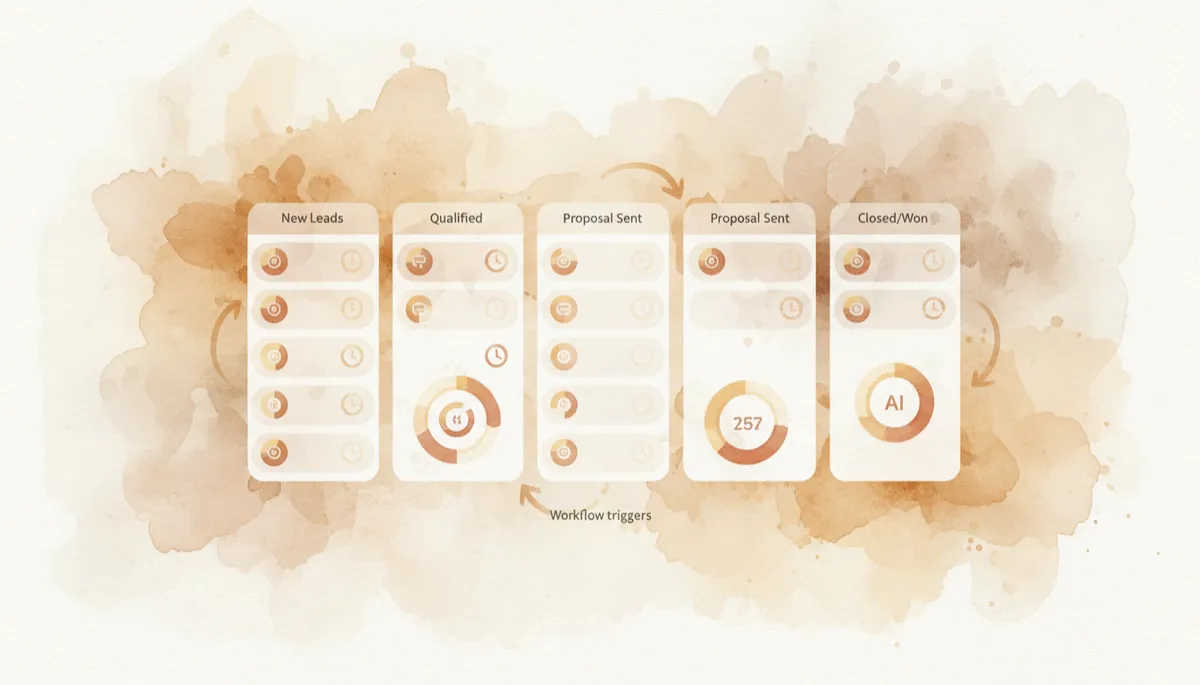
Well-structured CRM automation makes it obvious what needs attention today and what can run itself.
6. How Marketing, Websites, CRM, and Sales Processes Connect
Most businesses treat brand, website, marketing campaigns, and CRM as separate projects owned by different vendors. That’s why their Business Systems feel fragmented and fragile. House of Karma’s approach is different: we design your brand, funnels, and CRM as one ecosystem.
Here’s how the pieces should talk to each other:
Website → CRM: Every form, quiz, or booking tool pushes structured data into the CRM with clear source tracking and intent tags (e.g., “Strategy Session – High Intent” vs. “Newsletter Signup – Nurture”).
Marketing → CRM: Ad platforms, email tools, and social lead forms sync automatically. Campaign names, UTM parameters, and offers are visible on each contact, so you can trace revenue back to spend.
CRM → Sales Process: The CRM enforces your sales process: who owns which stage, what happens next, what “qualified” actually means, and when a deal is allowed to move forward.
Sales → Marketing Feedback: Closed-won and closed-lost reasons sync back to marketing so you stop guessing which messages attract buyers vs. time-wasters.
💡 Pro Tip: When we implement systems at House of Karma, we design the website forms, CRM fields, and pipeline stages together. That’s how you avoid the “marketing says one thing, sales tracks another” problem.
7. CRM vs. Spreadsheets: Why the Difference Matters
Spreadsheets are great for static analysis and quick experiments. They are terrible as live operating systems. Here’s the blunt breakdown from an operator’s perspective:
Aspect | Spreadsheet | CRM with Automation |
|---|---|---|
Data updates | Manual, error-prone, no audit trail | Automatic from forms, calls, emails, and integrations |
Follow-up | Depends on humans scanning rows and remembering | Automated sequences, tasks, and alerts trigger on time |
Collaboration | Overwritten cells, version chaos | Roles, permissions, and clear ownership per deal |
AI Integration | Almost none, data too unstructured | AI agents can summarize, score, and act on structured records |
If your revenue depends on a spreadsheet, you’re operating on luck and memory. A CRM with proper Workflow Optimization gives you control, accountability, and visibility—especially as you add team members and channels.
8. Why So Many CRM Implementations Fail
We’ve been brought in many times after a “failed CRM project” that cost months and real money. The pattern is consistent, and it has little to do with which platform you picked.
No clear sales process: You can’t automate what you haven’t defined. If your team sells differently every time, the CRM becomes a suggestion box, not a system.
Too much complexity, too fast: Overbuilt automations, dozens of pipelines, and fields no one uses. People revert to spreadsheets because the CRM feels heavy and confusing.
Poor data discipline: No rules for required fields, no ownership of data quality, and no training. Dirty data kills trust in reports, and once trust is gone, adoption dies with it.
Disconnected systems: Website forms go to inboxes, not the CRM. Marketing tools don’t sync. Finance runs separately. You end up with islands of information instead of a connected Business System.
📌 Operator Insight: Technology rarely fails on its own. It fails when there’s no clear owner, no defined process, and no enforcement. House of Karma starts with process and accountability, then layers technology on top.
9. Choosing or Building the Right CRM System for Your Stage
There is no universal “best CRM.” There is only the best fit for your current stage, complexity, and growth plans. Industry reviews consistently highlight tools like HubSpot, Pipedrive, Zoho, monday CRM, and Salesforce Starter for small to mid-sized teams—but the tool is only half the equation. The other half is how it’s architected for your reality.
A Practical Selection Checklist
Clarity of your sales process: Can the CRM mirror your stages, handoffs, and products without workarounds?
Integration with your stack: Does it connect cleanly to your website platform, email tools, payment systems, and project management?
Automation depth: Can it handle the level of CRM Automation you need now, with room to grow into more advanced workflows and AI agents later?
Reporting and visibility: Can leadership get clear answers without exporting to spreadsheets every week?
Usability for your team: Will your sales and ops teams actually use it daily, or does it feel like a punishment?
House of Karma often recommends starting with a flexible, mid-weight CRM that can scale—then building a lean, intentional setup first. Once the core pipeline and automations work reliably, we layer in more advanced AI and cross-system workflows.
10. Real-World Workflow Examples That Actually Move Revenue
Example 1: High-Intent Website Leads
A prospect books a “Strategy Session” on your site. Here’s how a well-built system handles it:
Form submission creates a contact, deal, and meeting in the CRM with source and campaign attached.
Automation sends a confirmation email, SMS reminder, and a short survey to qualify needs before the call.
AI summarizes the survey responses and past interactions into a one-page brief for the sales rep.
After the call, the rep selects an outcome; automation triggers proposal workflows, internal handoffs, or nurture paths accordingly.
Example 2: Reactivating Dormant Leads
You have 600 leads that went quiet after proposals. Instead of a one-off blast, a structured CRM automation might:
Segment leads by deal size, service type, and last engagement date.
Use AI to generate personalized check-in emails referencing their original goals and timeline.
Trigger a follow-up task only when a lead clicks or replies, so your team spends time on those showing real intent.
This is how Lead Management and AI Integration combine to create focused, revenue-producing activity instead of random outreach.
11. How House of Karma Designs and Implements Tailored CRM Systems
House of Karma doesn’t drop in a tool and disappear. We design Business Systems that match how you actually operate, then build the CRM, automations, and connected assets around that reality. Our work sits at the intersection of brand, web, and operations—so your story, funnels, and systems reinforce each other instead of fighting.
Our Typical Implementation Approach
Audit & mapping: We map your current lead sources, sales process, handoffs, and tech stack. We identify leaks, duplication, and manual bottlenecks.
Process design: Together, we define one clear, realistic sales process (or a small number of pipelines) and the minimum data required at each stage for reporting and AI.
System build: We configure the CRM, fields, automations, and integrations with your website, marketing tools, and delivery systems—keeping complexity in check.
Training & governance: We train your team on how to work inside the system, not around it. We define ownership, rules, and accountability so the system stays clean and usable.
Iteration: Once the core is stable, we layer on more advanced automations, AI agents, and cross-department workflows to support scale.
📌 Our Bias: Clarity over complexity. We’d rather you have one pipeline that everyone uses correctly than four that no one trusts.
12. FAQs on CRM Automation for Growing Businesses
“When is the right time to move from spreadsheets to a CRM?”
As soon as you have more leads than you can personally remember, or more than one person touching sales. If you’re losing track of follow-ups, double-contacting leads, or can’t answer “What’s in our pipeline right now?” without opening Excel, you’re already late.
“Will automation make our communication feel robotic?”
Only if it’s written that way. Automation is about timing and reliability, not generic tone. We design sequences that sound like your brand and use AI to personalize at scale—while keeping humans in the loop for key moments.
“How long does a proper CRM implementation take?”
A focused, well-scoped rollout for a small to mid-sized team typically takes 4–8 weeks: discovery, design, build, testing, and training. Larger, multi-department systems with deep Workflow Optimization and AI Integration can take longer—but the key is phasing: get a lean version live, then iterate.
“Do we need a ‘big name’ CRM to benefit from AI and automation?”
No. Many modern CRMs—HubSpot, Pipedrive, Zoho, Salesforce Starter, and others—offer strong automation and AI features. The real differentiator is how well the system is architected for your business and how disciplined your team is in using it.
Bringing It All Together: Build a System That Can Actually Scale
CRM Automation, when done properly, is not a “nice-to-have software project.” It’s the backbone of how your brand attracts, manages, and retains customers. It connects your website, campaigns, sales conversations, and delivery into a single, coherent Business System—one that gives you control instead of constant firefighting.
If you’re ready to move from scattered tools and spreadsheets to a clear, automated, AI-ready CRM ecosystem, House of Karma can help you design and implement it with intention. We build brands with backbone—and the systems behind them that turn attention into predictable revenue.
Next Step: Book a discovery session with House of Karma to map your current lead flow, identify the biggest leaks, and design a CRM and automation blueprint built to help your business grow without chaos.
13. Additional FAQs on AI-Ready CRM Systems and House of Karma’s Services
“What does an AI-ready CRM setup from House of Karma actually include?”
An AI-ready CRM from House of Karma includes clean data structures, clearly defined pipelines, standardized fields, and automation frameworks that AI agents can reliably act on. We configure lead capture, routing, scoring, activity logging, and next-best-action prompts, then connect these to your website, forms, calendars, and core tools. The result is a CRM that can support current automation and future AI capabilities without needing to be rebuilt from scratch.
“Can House of Karma migrate our existing CRM, spreadsheets, and tools into one unified system?”
Yes. System consolidation and migration is a core part of our work. House of Karma audits your current CRMs, spreadsheets, forms, and marketing tools, then designs a single source of truth. We clean and normalize your data, map old fields to new structures, and build integrations so that website, ads, email, and sales activity all land in one organized CRM. You end up with fewer tools, less manual work, and a clearer view of your pipeline.
“How does House of Karma connect branding, website design, and CRM automation?”
We treat your brand, website, and CRM as one ecosystem, not separate projects. Our team first clarifies your positioning, offers, and messaging. Then we design a site and funnels that express that story clearly and convert the right visitors. In parallel, we architect your CRM pipelines, fields, and automations so that every form, quiz, and booking feeds cleanly into your system. The same narrative and strategy carry from ad to landing page to sales call to onboarding.
“What industries does House of Karma typically build CRM and automation systems for?”
House of Karma primarily serves service-based and expertise-driven businesses: agencies, coaches and consultants, creative studios, B2B services, high-ticket education, and professional services. These businesses rely on leads, calls, proposals, and long-term relationships, which makes CRM Automation and AI-driven follow-up especially valuable. If your revenue depends on conversations and trust, our systems are designed for you.
“How does House of Karma use AI inside CRM workflows without losing our brand voice?”
We start by defining your brand voice, tone, and boundaries. Then we configure AI tools to draft emails, summaries, and follow-ups using that voice as a template—not generic copy. Humans remain in control for key touchpoints, while AI handles summaries, personalization, and suggestions. Our goal is to make your communication more consistent and on-brand, not robotic. AI becomes a smart assistant, not the author of your relationships.
“Can House of Karma help if we already have a CRM but it’s a mess?”
Absolutely. Many clients come to House of Karma with a half-built or overbuilt CRM that no one trusts. We perform a structured audit, identify what to keep, what to simplify, and what to retire, then rebuild your pipelines, fields, and automations around a clear process. Often we reduce the number of pipelines, tags, and workflows so your team can finally use the system confidently and your reports start telling the truth again.
“What’s the difference between working with House of Karma and hiring a generic CRM consultant?”
Most CRM consultants only touch the software. House of Karma works at the intersection of brand, web, and operations. We don’t just configure fields and automations—we align your positioning, offers, website flows, sales scripts, and reporting so everything supports one strategy. Our focus is not “more features,” but clear structure that drives revenue and gives you control as you scale.
“How do you measure success for a CRM and automation project with House of Karma?”
We define success in operational and revenue terms, not just “the system is live.” Typical success metrics include: higher show-up rates for calls, faster follow-up times, increased close rates by stage, more revenue tracked back to campaigns, and fewer leads slipping through the cracks. We also look at adoption: are your team members actually using the CRM daily, and can leadership get answers in a few clicks instead of a weekly data scramble?
“Can House of Karma support us after the initial CRM build is complete?”
Yes. Many clients choose ongoing systems and growth support with House of Karma. That can include maintaining and refining automations, adding new pipelines or offers, improving dashboards, testing AI agents, and aligning new campaigns with your existing infrastructure. As your business evolves, we help your brand, website, and CRM evolve with it—so your system stays an asset, not a bottleneck.
“How do we get started with House of Karma for CRM, automation, and AI?”
The first step is a discovery session. We walk through your current lead flow, tools, offers, and goals, then outline a practical roadmap: what to fix first, what to simplify, and where automation and AI can create the most leverage. From there, House of Karma can lead a full brand, web, and CRM build or focus specifically on CRM Automation and Business Systems—always with clarity, structure, and long-term scalability in mind.